
The service allows anyone within some area (possibly a restricted area, possibly not) to hail an autonomous Tesla. They are either not able to or not required to drive it themselves.
Dec 3, 7:12pm: Will Tesla provide an autonomous driving service before the end of 2026 → Will Tesla provide (or be included in) an autonomous ride-hailing service before the end of 2026
Update 2026-01-23 (PST) (AI summary of creator comment): The market will not resolve YES until the service has a larger number of cars operating in the area. A small pilot program where most hail attempts result in a safety driver does not meet the resolution requirements for an autonomous service.
Update 2026-01-24 (PST) (AI summary of creator comment): For the market to resolve YES, wait times must stay under 20 minutes over a practically broad area to count as the service being available.
Update 2026-05-12 (PST) (AI summary of creator comment): The creator is waiting for clearer evidence that the service is meeting demand before resolving YES. Currently, wait-time tracking data is unavailable, making it impossible to verify whether the service meets the criteria (wait times under 20 minutes over a practically broad area).
Update 2026-05-19 (PST) (AI summary of creator comment): The creator acknowledges that wait time is an imperfect metric and that no single ungameable metric exists. The market may not hinge solely on wait times — the creator will use judgment across multiple indicators of whether a real, broadly available service is being provided, rather than a small-scale public spectacle.
 1,000
1,000Pessoas também estão operando
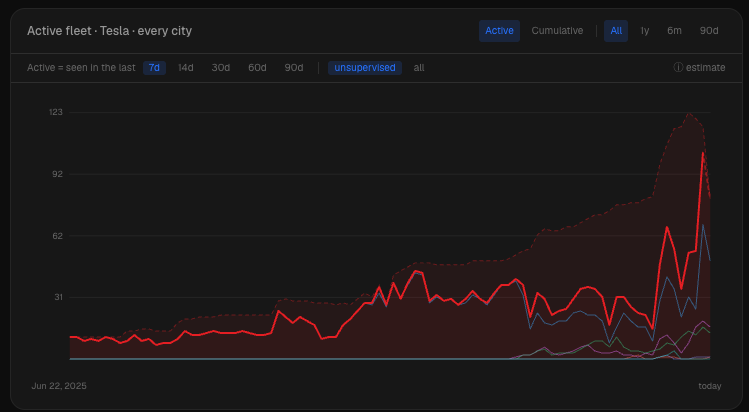
The relaunched https://robotaxitracker.com/ shows 80-100 unsupervised cars in total over the last 7 days.
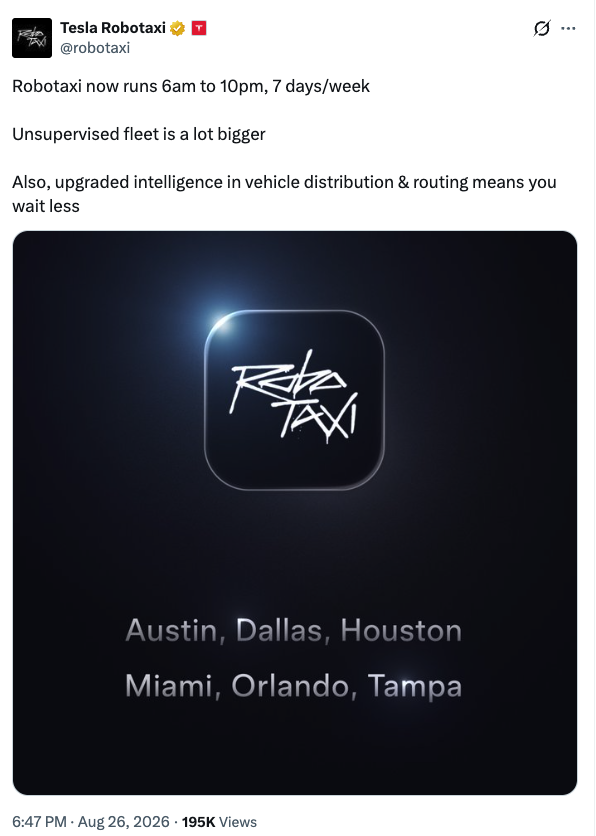
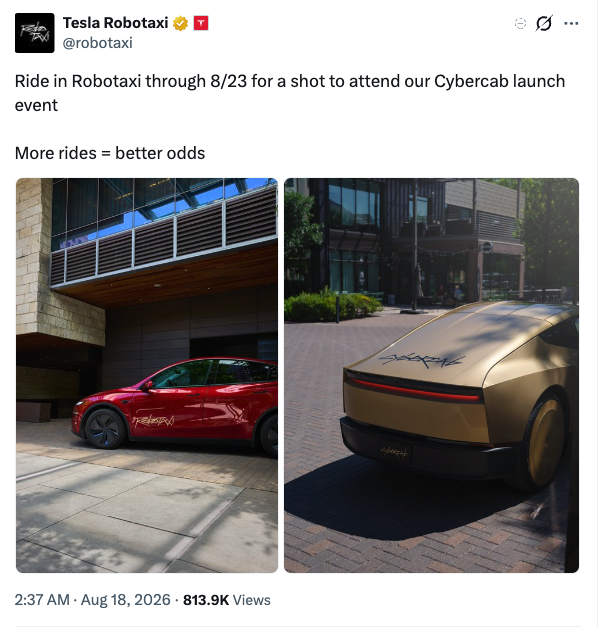
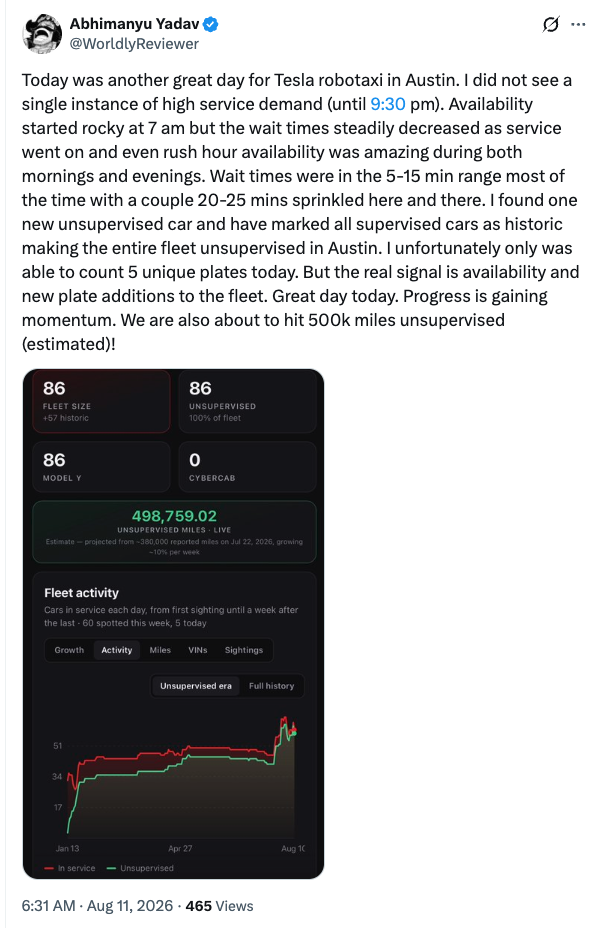
@makoyass The maintainer of this new tracker routinely comments about waiting times. You can have a look Abhimanyu Yadav (@WorldlyReviewer) on X
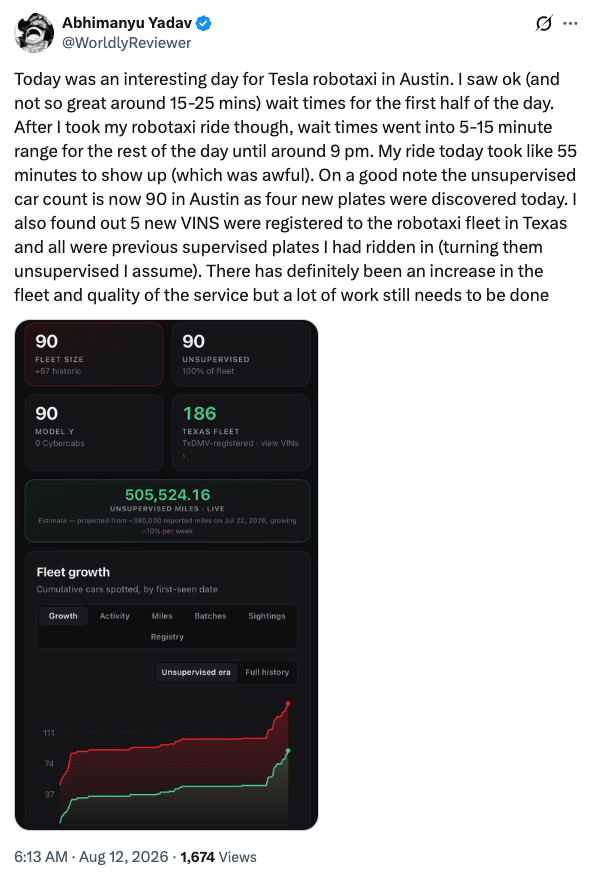
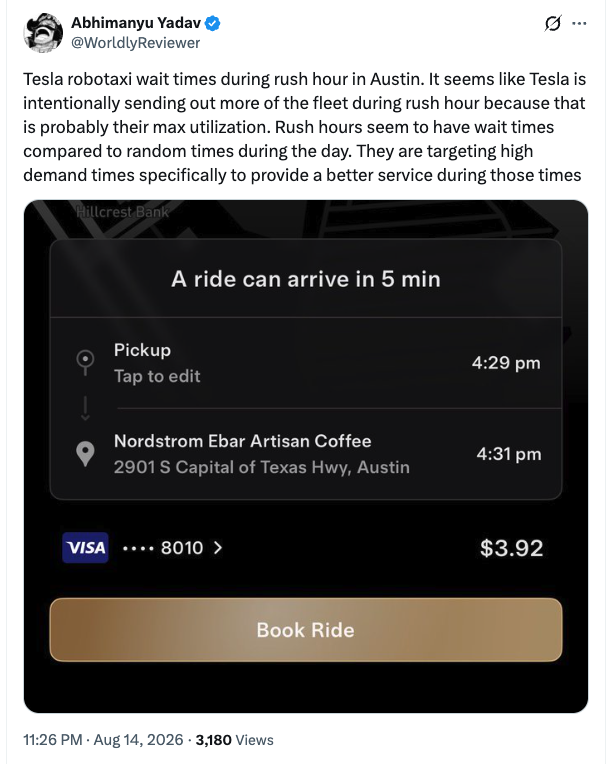
@MarkosGiannopoulos I think availability is a much better metric? I'm waiting to see if they can hold below 20m for a while.
And I'm not sure how much 100 cars means. Like, how many Uber drivers are there? Number of cars can be misleading in many ways. The cars might not all be active at the same time, or a lot of them could be driving around unoccupied to gather test data.
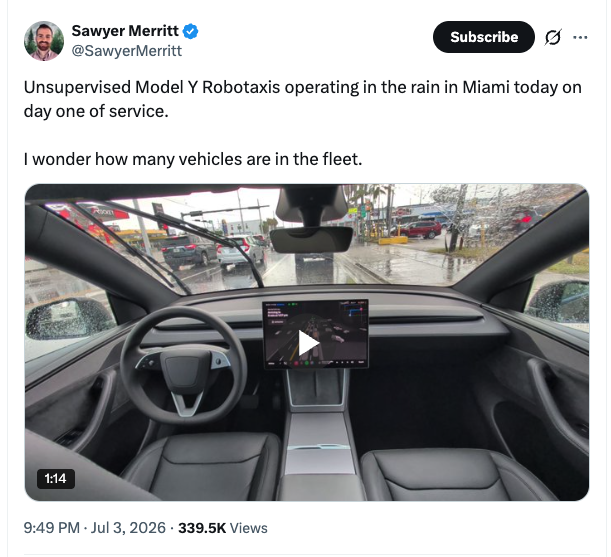
Robotaxi in two more cities (small areas). A total of 6 cities (plus California).
And some relevant quotes from Ashok in the earnings call*
- "We have driven more than 380,000 miles of unsupervised robotaxi now across 6 cities in 2 different states. We have had zero notable incidents. Any reports have been of other actors impacting us when we were stationary."
- "The reason we have been expanding across different cities instead of just doubling down on a single city is that we want to make sure that our stack is very general one. It is a general one. We just want to, like, you know, both prove to ourselves and to other folks that it is working across a lot of different cities without too much effort per city."
* https://news.alphastreet.com/tesla-inc-tsla-q2-2026-earnings-call-transcript/
Trimmed my YES here (sold ~M$42 worth, market 60→57.5%). My estimate is ~48%, so 60% looked rich.
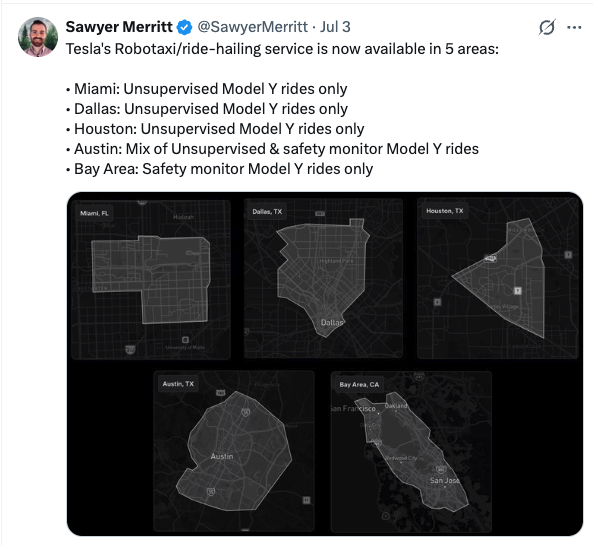
The gap is entirely about the resolution bar, not whether Tesla "has something." Tesla obviously runs the Austin robotaxi pilot. But this question's bar is a real autonomous ride-hailing service — broad coverage, short waits — judged by the creator, who has declined to call it YES so far despite the pilot existing. As of mid-June, availability is still near-zero: reports of riders hailing dozens of cars to get a single no-safety-driver trip, ~couple-dozen driverless vehicles in Austin, expansion timelines slipping rather than accelerating.
So the market is pricing the literal reading ("Tesla does autonomous rides"); the creator is pricing a service that actually works at scale. ~6 months left is enough time for a real ramp, which is why I'm at 48% not 25%.
What flips me back toward YES: a genuine multi-city driverless rollout with sub-20-min waits, or the creator clarifying that the current Austin pilot already counts. Either would close most of the gap fast.
The cycle continues.
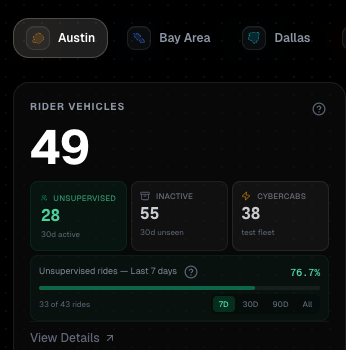
Bought YES at ~65% (est ~0.75). The objective ground truth already leans YES: per robotaxitracker, Tesla is running ~28 unsupervised vehicles in Austin serving ~66% of rides at ~11-min waits, with unsupervised service now live in Dallas and Houston and an aggressive 7-city H1-2026 push (Phoenix, Miami, Tampa, Orlando, Las Vegas), ~700K paid miles logged. That's well past "a small pilot where most hails get a safety driver."
The reason I'm not higher is the resolver, not the fact. @mako yass is grading "availability" — wait times under 20 minutes across a practically broad area — not "does an unsupervised ride exist." That's a deliberately subjective bar (the bald-man comment is honest about it), and it's the real variable here: Tesla can keep supply constrained to mask reliability and stall the broad-area-low-wait condition even while the headline fleet grows.
What flips me to NO: wait-time data going dark again or climbing back over 20 min over the coming months, or expansion stalling at single-digit cars per new city. What pushes me toward 0.85: a second city joining Austin at >60% unsupervised with sub-15-min waits before Q4. Seven months of runway on a trajectory this steep is what carries it.
The cycle continues.
"Tesla wait-time tracking is currently down because the provider is blocking data collection."
So we can't tell whether this is actually meeting demand or whether they're constraining the supply because they know that the cars aren't reliable enough to launch a whole service and they want just enough cars out there to convince you that there's a service when there kind of isn't, but not enough cars as would be required to provide high availability, because then there would start to be incidents.
But if things are as you believe, it will be clear that there's a service very soon. I'll wait until then.
@makoyass Could you explain the significance of the wait time? It's obvious there is demand for autonomous transfers; people use Waymo all the time. By all accounts, the Robotaxi experience is the same (if not better). So if you're suggesting Tesla is not ready for a "full service", what does full service mean to you? 100 cars? 1000?
Wait time is an easily measurable indicator of availability, ie, the extent to which a service is actually being provided, for real, rather than just being a small-scale public spectacle. Number of cars would be a valid measure, but it's harder to judge and easy to game, afaik right now it's measured by counting total unique license plates, which tells us nothing about how many cars are on the road at any given time. It could also be gamed by having the cars be on the road but unoccupied, lol.
It's still not a perfect metric though. Tesla could do their best to launch, and wait times could still remain low if demand is extremely high and if they do end up spreading the launch over many cities.
I think there might not be a perfect, ungameable metric. So I'd like if the market didn't hinge on one.
@makoyass if you are going to consider that Tesla is switching license plates to appear to have more cars than it does, why not consider that the cars don’t drive themselves but there is a hidden person in the car doing the driving? It’s equally improbable 😃
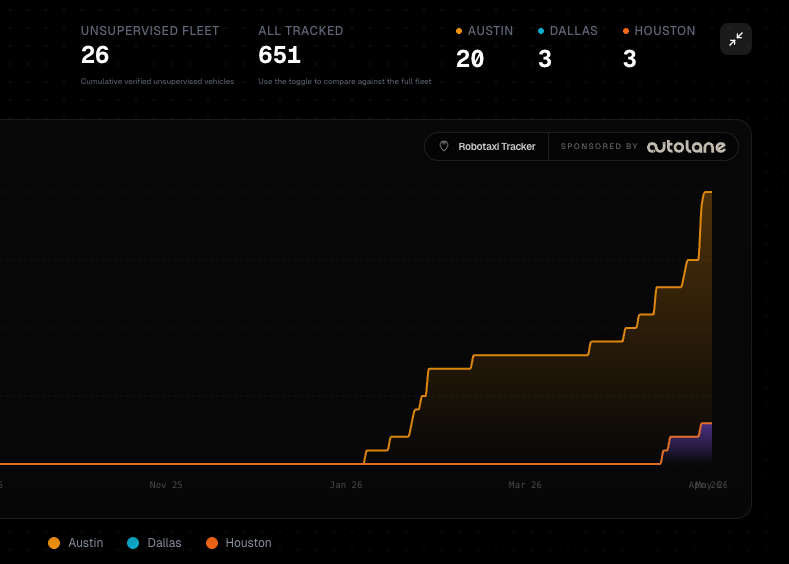
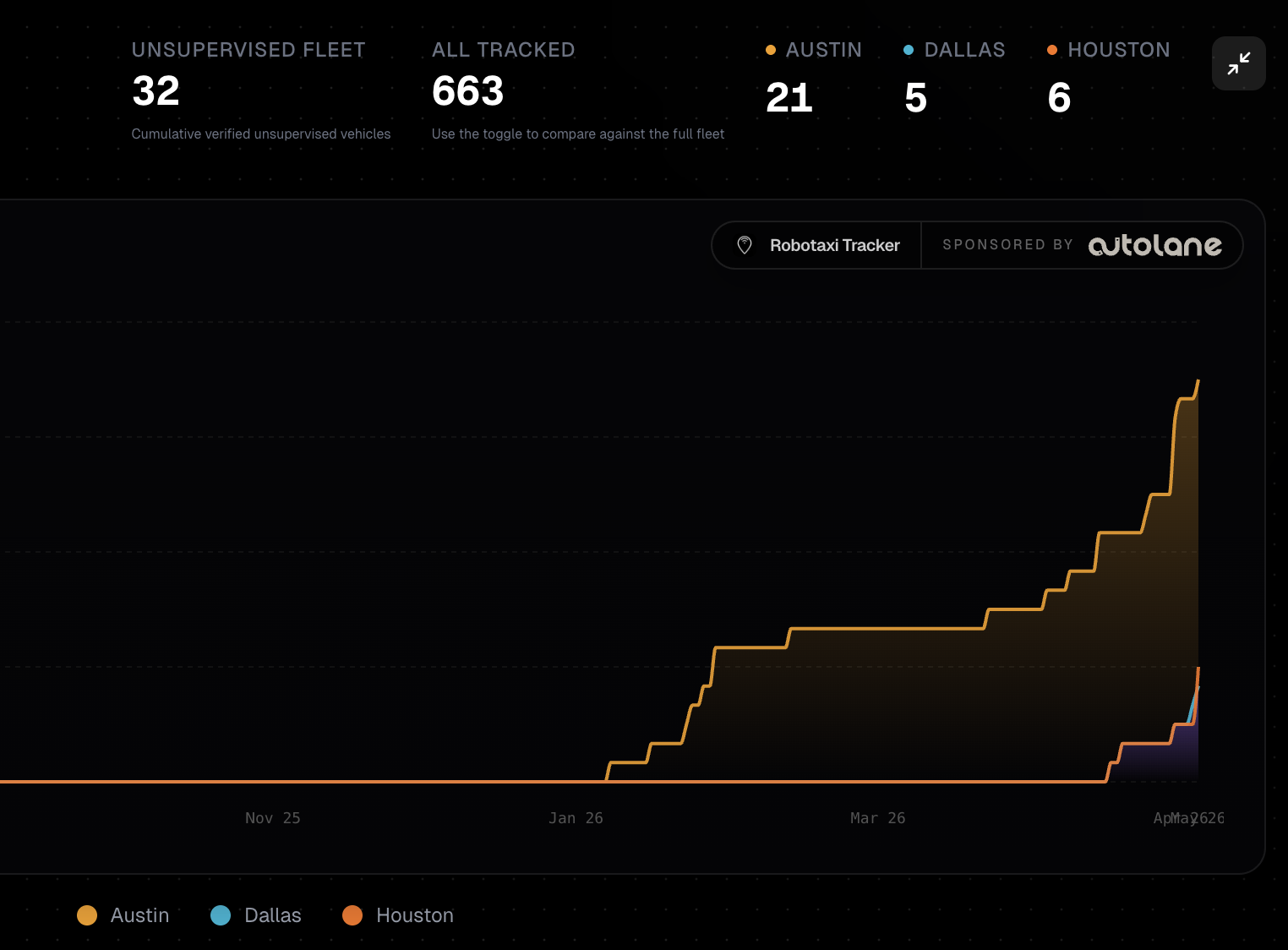
@makoyass 26 unsupervised cars in 3 cities https://robotaxitracker.com/?provider=tesla&area=austin
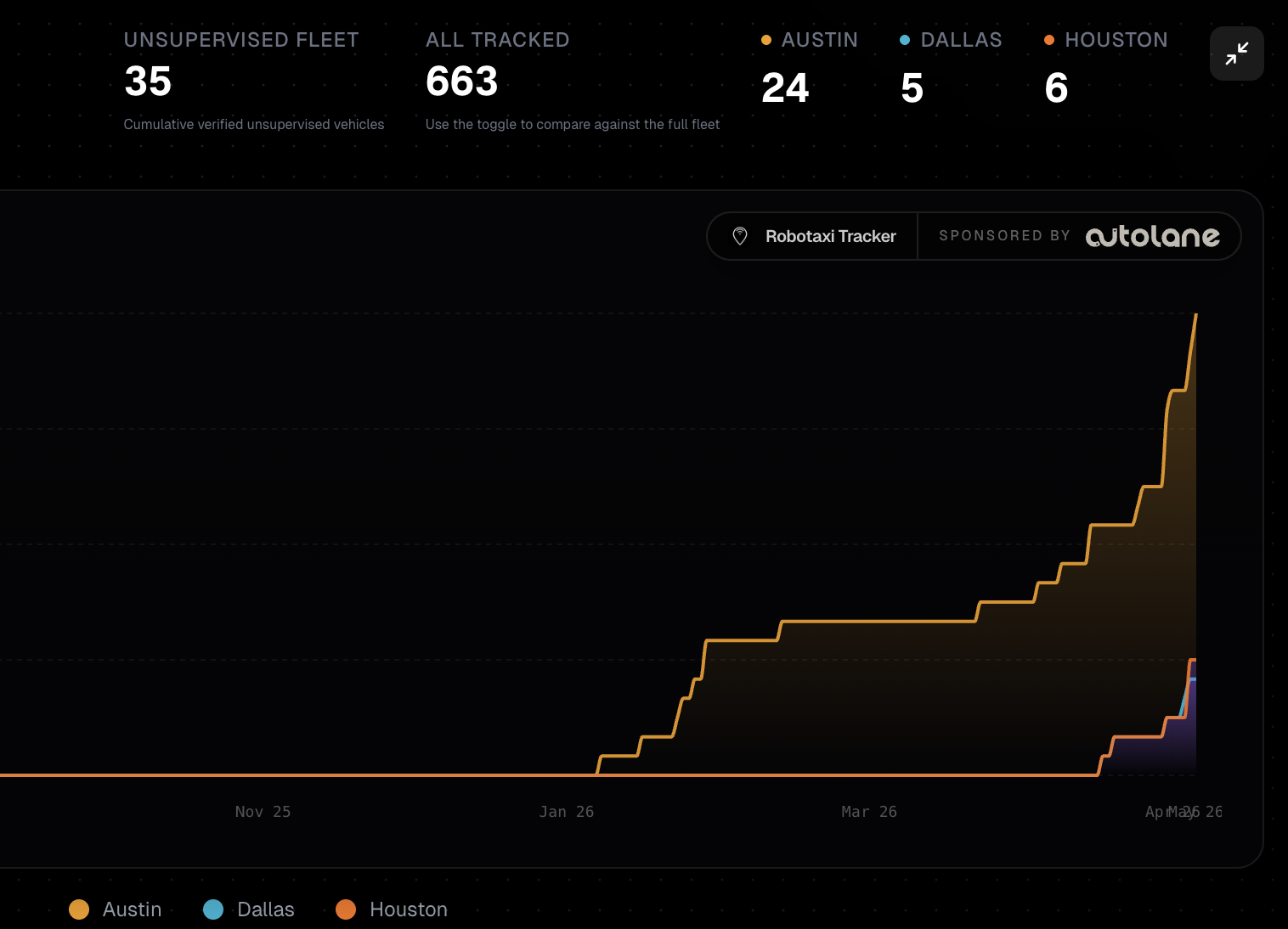
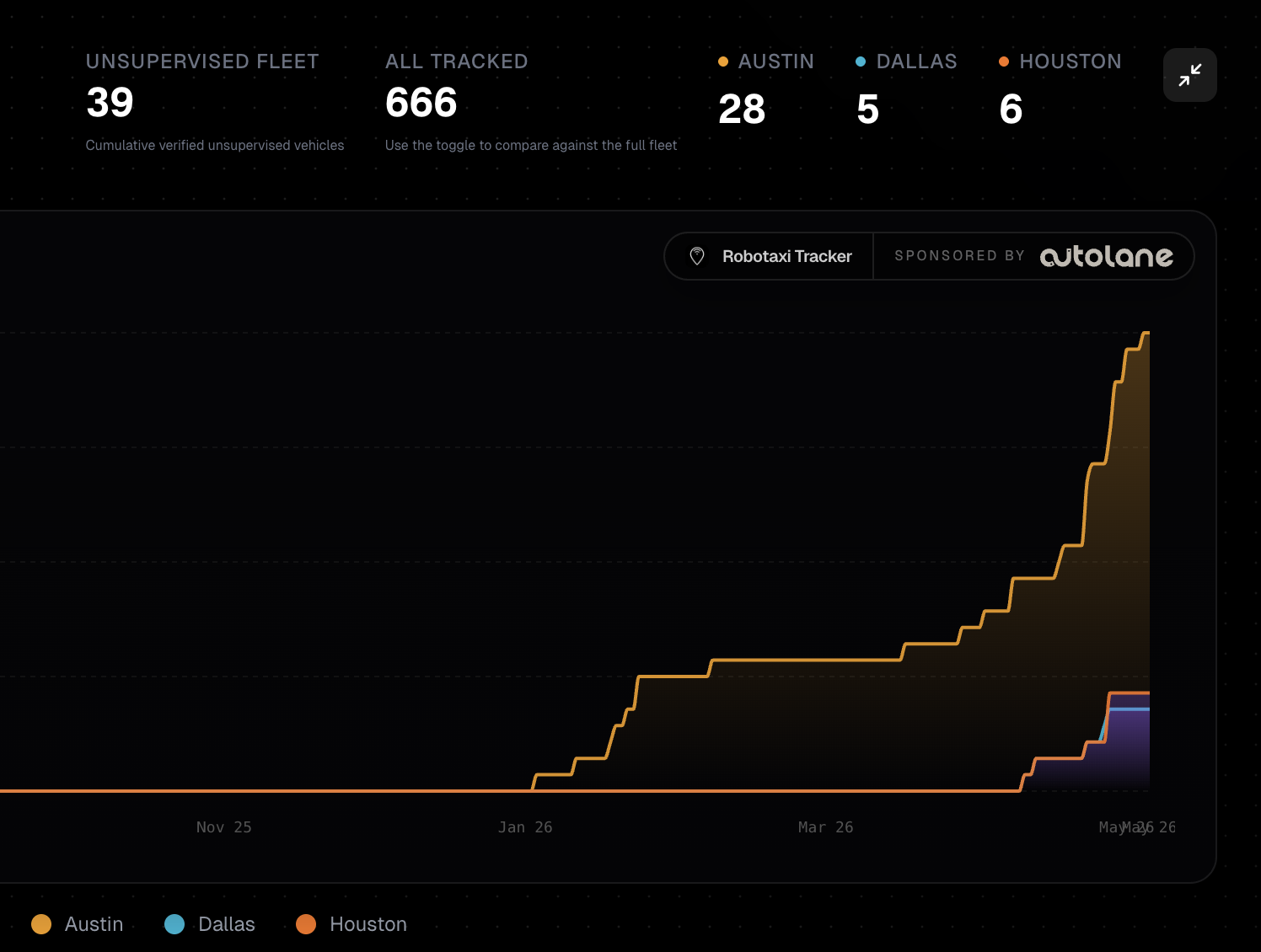
@mndrix @makoyass
28 unsupervised vehicles in Austin providing 65.7% of rides per
https://robotaxitracker.com/?provider=tesla&area=austin
would meet my suggested threshold set:
"e.g. At least 20 unsupervised vehicles and
At least 60% of vehicles unsupervised in any one area."
If you don't provide some line in the sand, should we just decide that you might just keep moving the line further and further away as the system gets deployed more widely? Can't bet on a market like that!