Elon Musk has been very explicit in promising a robotaxi launch in Austin in June with unsupervised full self-driving (FSD). We'll give him some leeway on the timing and say this counts as a YES if it happens by the end of August.
As of April 2025, Tesla seems to be testing this with employees and with supervised FSD and doubling down on the public Austin launch.
PS: A big monkey wrench no one anticipated when we created this market is how to treat the passenger-seat safety monitors. See FAQ9 for how we're trying to handle that in a principled way. Tesla is very polarizing and I know it's "obvious" to one side that safety monitors = "supervised" and that it's equally obvious to the other side that the driver's seat being empty is what matters. I can't emphasize enough how not obvious any of this is. At least so far, speaking now in August 2025.
FAQ
1. Does it have to be a public launch?
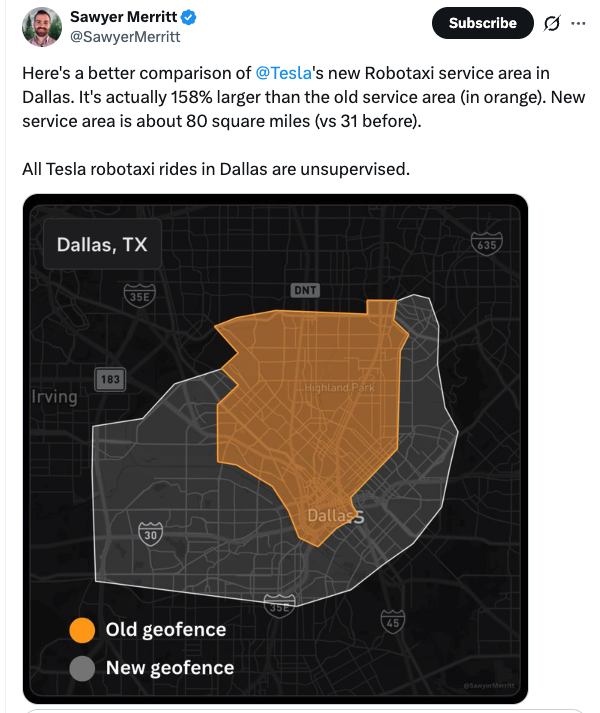
Yes, but we won't quibble about waitlists. As long as even 10 non-handpicked members of the public have used the service by the end of August, that's a YES. Also if there's a waitlist, anyone has to be able to get on it and there has to be intent to scale up. In other words, Tesla robotaxis have to be actually becoming a thing, with summer 2025 as when it started.
If it's invite-only and Tesla is hand-picking people, that's not a public launch. If it's viral-style invites with exponential growth from the start, that's likely to be within the spirit of a public launch.
A potential litmus test is whether serious journalists and Tesla haters end up able to try the service.
UPDATE: We're deeming this to be satisfied.
2. What if there's a human backup driver in the driver's seat?
This importantly does not count. That's supervised FSD.
3. But what if the backup driver never actually intervenes?
Compare to Waymo, which goes millions of miles between [injury-causing] incidents. If there's a backup driver we're going to presume that it's because interventions are still needed, even if rarely.
4. What if it's only available for certain fixed routes?
That would resolve NO. It has to be available on unrestricted public roads [restrictions like no highways is ok] and you have to be able to choose an arbitrary destination. I.e., it has to count as a taxi service.
5. What if it's only available in a certain neighborhood?
This we'll allow. It just has to be a big enough neighborhood that it makes sense to use a taxi. Basically anything that isn't a drastic restriction of the environment.
6. What if they drop the robotaxi part but roll out unsupervised FSD to Tesla owners?
This is unlikely but if this were level 4+ autonomy where you could send your car by itself to pick up a friend, we'd call that a YES per the spirit of the question.
7. What about level 3 autonomy?
Level 3 means you don't have to actively supervise the driving (like you can read a book in the driver's seat) as long as you're available to immediately take over when the car beeps at you. This would be tantalizingly close and a very big deal but is ultimately a NO. My reason to be picky about this is that a big part of the spirit of the question is whether Tesla will catch up to Waymo, technologically if not in scale at first.
8. What about tele-operation?
The short answer is that that's not level 4 autonomy so that would resolve NO for this market. This is a common misconception about Waymo's phone-a-human feature. It's not remotely (ha) like a human with a VR headset steering and braking. If that ever happened it would count as a disengagement and have to be reported. See Waymo's blog post with examples and screencaps of the cars needing remote assistance.
To get technical about the boundary between a remote human giving guidance to the car vs remotely operating it, grep "remote assistance" in Waymo's advice letter filed with the California Public Utilities Commission last month. Excerpt:
The Waymo AV [autonomous vehicle] sometimes reaches out to Waymo Remote Assistance for additional information to contextualize its environment. The Waymo Remote Assistance team supports the Waymo AV with information and suggestions [...] Assistance is designed to be provided quickly - in a mater of seconds - to help get the Waymo AV on its way with minimal delay. For a majority of requests that the Waymo AV makes during everyday driving, the Waymo AV is able to proceed driving autonomously on its own. In very limited circumstances such as to facilitate movement of the AV out of a freeway lane onto an adjacent shoulder, if possible, our Event Response agents are able to remotely move the Waymo AV under strict parameters, including at a very low speed over a very short distance.
Tentatively, Tesla needs to meet the bar for autonomy that Waymo has set. But if there are edge cases where Tesla is close enough in spirit, we can debate that in the comments.
9. What about human safety monitors in the passenger seat?
Oh geez, it's like Elon Musk is trolling us to maximize the ambiguity of these market resolutions. Tentatively (we'll keep discussing in the comments) my verdict on this question depends on whether the human safety monitor has to be eyes-on-the-road the whole time with their finger on a kill switch or emergency brake. If so, I believe that's still level 2 autonomy. Or sub-4 in any case.
See also FAQ3 for why this matters even if a kill switch is never actually used. We need there not only to be no actual disengagements but no counterfactual disengagements. Like imagine that these robotaxis would totally mow down a kid who ran into the road. That would mean a safety monitor with an emergency brake is necessary, even if no kids happen to jump in front of any robotaxis before this market closes. Waymo, per the definition of level 4 autonomy, does not have that kind of supervised self-driving.
10. Will we ultimately trust Tesla if it reports it's genuinely level 4?
I want to avoid this since I don't think Tesla has exactly earned our trust on this. I believe the truth will come out if we wait long enough, so that's what I'll be inclined to do. If the truth seems impossible for us to ascertain, we can consider resolve-to-PROB.
11. Will we trust government certification that it's level 4?
Yes, I think this is the right standard. Elon Musk said on 2025-07-09 that Tesla was waiting on regulatory approval for robotaxis in California and expected to launch in the Bay Area "in a month or two". I'm not sure what such approval implies about autonomy level but I expect it to be evidence in favor. (And if it starts to look like Musk was bullshitting, that would be evidence against.)
12. What if it's still ambiguous on August 31?
Then we'll extend the market close. The deadline for Tesla to meet the criteria for a launch is August 31 regardless. We just may need more time to determine, in retrospect, whether it counted by then. I suspect that with enough hindsight the ambiguity will resolve. Note in particular FAQ1 which says that Tesla robotaxis have to be becoming a thing (what "a thing" is is TBD but something about ubiquity and availability) with summer 2025 as when it started. Basically, we may need to look back on summer 2025 and decide whether that was a controlled demo, done before they actually had level 4 autonomy, or whether they had it and just were scaling up slowing and cautiously at first.
13. If safety monitors are still present, say, a year later, is there any way for this to resolve YES?
No, that's well past the point of presuming that Tesla had not achieved level 4 autonomy in summer 2025.
14. What if they ditch the safety monitors after August 31st but tele-operation is still a question mark?
We'll also need transparency about tele-operation and disengagements. If that doesn't happen by June 22, 2026 (a year after the robotaxi launch) then that too is a presumed NO.
Ask more clarifying questions! I'll be super transparent about my thinking and will make sure the resolution is fair if I have a conflict of interest due to my position in this market.
[Ignore any auto-generated clarifications below this line. I'll add to the FAQ as needed.]
Update 2025-11-01 (PST) (AI summary of creator comment): The creator is [tentatively] proposing a new necessary condition for YES resolution: the graph of driver-out miles (miles without a safety driver in the driver's seat) should go roughly exponential in the year following the initial launch. If the graph is flat or going down (as it may have done in October 2025), that would be a sufficient condition for NO resolution.
Update 2025-12-10 (PST) (AI summary of creator comment): The creator has indicated that Elon Musk's November 6th, 2025 statement ("Now that we believe we have full self-driving / autonomy solved, or within a few months of having unsupervised autonomy solved... We're on the cusp of that") appears to be an admission that the cars weren't level 4 in August 2025. The creator is open to counterarguments but views this as evidence against YES resolution.
Update 2025-12-10 (PST) (AI summary of creator comment): The creator clarified that presence of safety monitors alone is not dispositive for determining if the service meets level 4 autonomy. What matters is whether the safety monitor is necessary for safety (e.g., having their finger on a kill switch).
Additionally, if Tesla doesn't remove safety monitors until deploying a markedly bigger AI model, that would be evidence the previous AI model was not level 4 autonomous.
Update 2026-01-31 (PST) (AI summary of creator comment): The creator clarified that passenger-seat emergency stop buttons should be evaluated based on their function:
If the button is a real-time "hit the brakes we're gonna crash!" intervention button, this would indicate supervision that could rule out level 4 autonomy
If the button is a "stop requested as soon as safely possible" button (where the car remains in control until safely stopped), this would not rule out level 4 autonomy
This distinction applies to both Waymo (the benchmark) and Tesla. The creator emphasized that mere presence of a safety monitor doesn't rule out level 4 - what matters is whether there is supervision with the ability to intervene in real time.
Update 2026-02-01 (PST) (AI summary of creator comment): The creator has proposed a concrete scenario for June 22, 2026 (the one-year deadline from FAQ14) that would result in NO resolution:
(a) Longer zero-intervention streaks but not to the point that unsupervised FSD is safer than humans
(b) More unsupervised robotaxi rides but not at a scale where tele-operation becomes implausible
(c) Continued lack of transparency on disengagements
(d) Creative new milestones that seem like watersheds but turn out to be closer to controlled demos
Conversely, if Tesla demonstrates a clear step change in autonomy before June 22, 2026 (such as declaring victory, opening up about disengagements, and shooting past Waymo), there would still be a debate about whether Tesla was at level 4 on August 31, 2025, but it would be more reasonable to give Tesla the benefit of the doubt on questions about tele-operation and kill switches.
Update 2026-02-02 (PST) (AI summary of creator comment): The creator has clarified terminology and concepts around supervision and disengagement:
Supervision refers to a human in the loop in real time, watching the road and able to intervene.
Real-time disengagement is when a human supervisor intervenes to control the car in some way - a gap in the car's autonomy. If the car stops on its own and asks for help or needs rescuing, those might count as other kinds of disengagement but not a real-time disengagement.
Evidence threshold: Human drivers have fatalities roughly once per 100 million miles, or non-fatal crashes every half million miles. A supervised self-driving car needs to go hundreds of thousands of miles between real-time disengagements before we have much evidence it's human-level safe.
With less than 100k robotaxi miles, seeing zero real-time disengagements would still be fairly weak evidence that the robotaxis would crash less than humans when unsupervised.
For miles with an empty driver's seat, we need to know:
If safety monitors had the ability to intervene with a passenger-side kill switch
If that kill switch was real-time (like an emergency brake) or just a request for the car to autonomously come to a stop as quickly as possible
If the robotaxis have been remotely supervised (using the definition of supervision from FAQ8)
Update 2026-02-02 (PST) (AI summary of creator comment): The creator has analyzed data suggesting Tesla robotaxis may have markedly worse safety than human drivers, even with supervision. If this analysis is fair, the creator indicates that Tesla's safety record could be too far below human-level to count as level 4 autonomy, regardless of questions about kill switches or remote supervision.
The creator notes that human-level safety has been assumed as a lower bound for level 4 autonomy throughout this market. A safety record significantly worse than human drivers would not meet the level 4 standard, even if other technical criteria were satisfied.
The creator acknowledges a possible Tesla-optimist interpretation: that Musk "jumped the gun" in summer 2025 but may have achieved unsupervised FSD later (possibly January 2026). However, this would still result in NO resolution for this market, since the criteria must be met by August 31, 2025.
 1,000
1,000Pessoas também estão operando
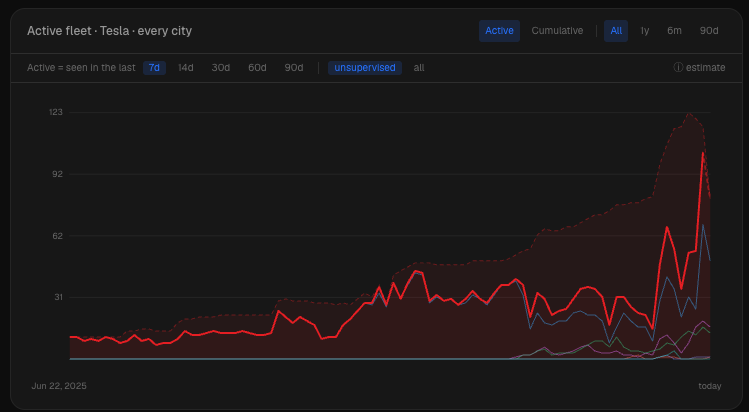
The relaunched https://robotaxitracker.com/ shows 80-100 unsupervised cars in total over the last 7 days.
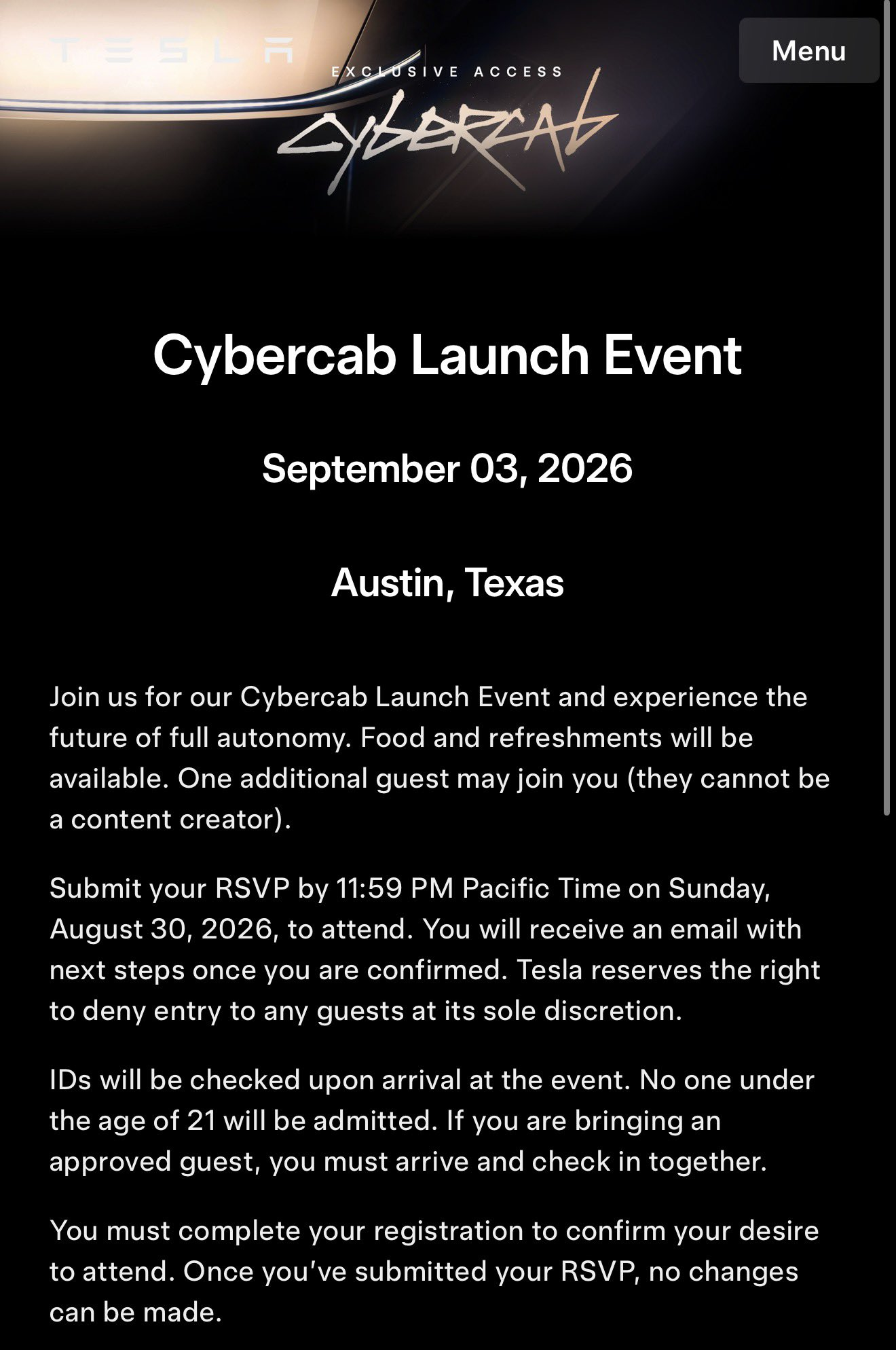
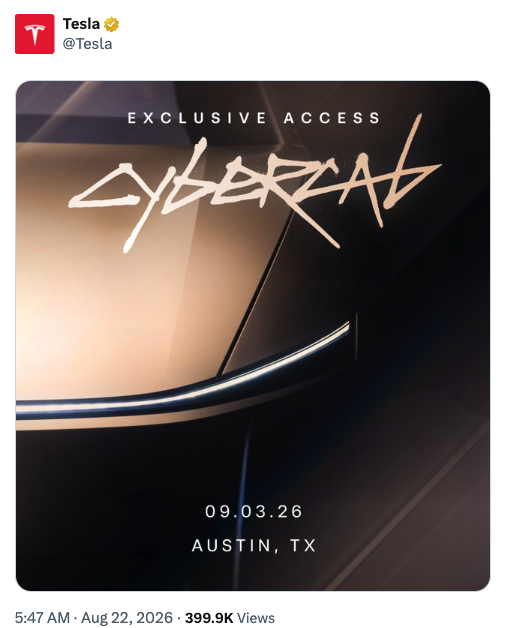
@MarkosGiannopoulos Edge of seat! The maximally cynical take, I guess, would be that they've all but paused the whole program --
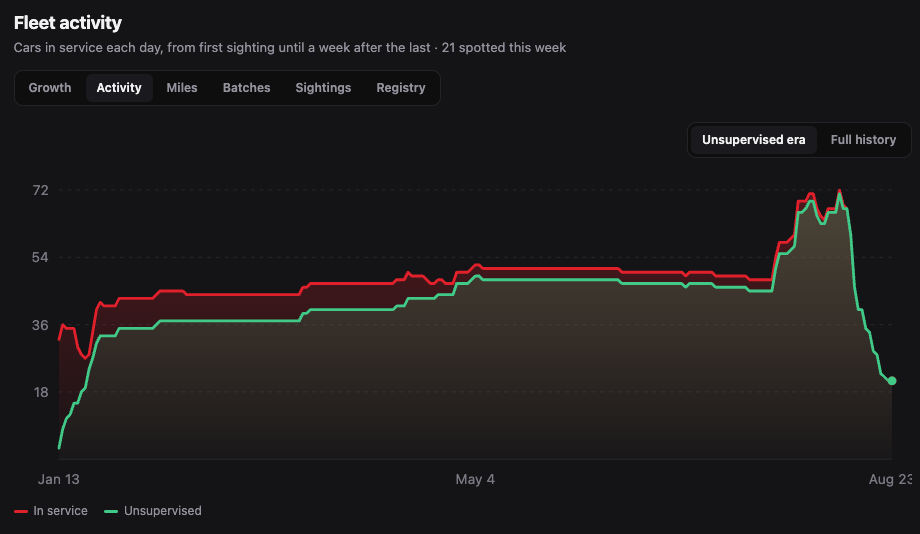
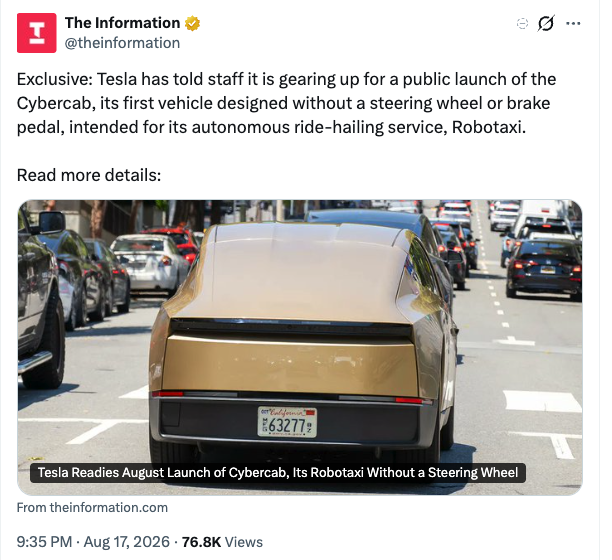
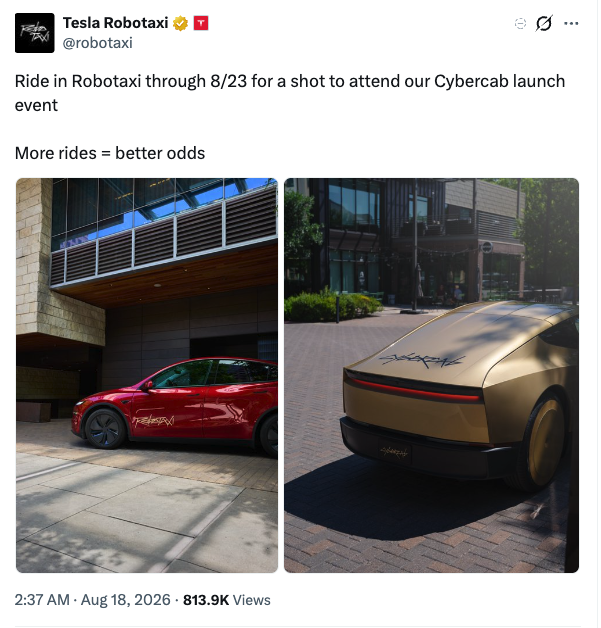
-- and that this Cybercab "launch" event is specifically constructed to distract from that. Anything they can do to generate headlines without actually scaling up. But I guess if they have 100 roadworthy cybercabs, that will in fact be a step up from what they've had so far. We'll see. I continue to keep teslapologetics.dreev.es up to date with the latest data.
@dreev Not sure how you can so easily discard Tesla deploying a purpose-built vehicle with no steering wheel to paying customers. Waymo has never carried a paying customer in a vehicle without a steering wheel.
Btw, where is the screenshot from?
Waymo, before it was called Waymo, did have these for a while:
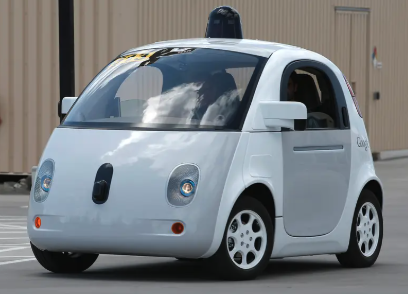
No steering wheel or pedals but no paying customers back then.
I'm not saying I agree with the maximally cynical take on Tesla's Cybercab launch but they sure haven't earned the maximally charitable take either.
My current prediction is that in terms of level 4 autonomy, Tesla stays at demo/pilot scale at least through the end of 2026. I guess my 80% confidence interval on when it goes properly exponential is 2027 to 2032. So less than 10% chance it happens in 2026 and less than 10% it takes more than like 6 years from now.
(I'm probably similar for Tesla allowing empty driver's seats or at least level 3 autonomy for privately owned Teslas. Recall level 3 means the car needs you to be ready if it beeps for you to take over but if it doesn't beep, the car is fully responsible. If it were to crash, it would officially be the car's fault.)
The screenshot is from the new robotaxi tracker you found: https://austin-robotaxi-tracker.netlify.app/
@dreev I’m not sure how accurate this tracker is these days because the original one has been relaunched https://robotaxitracker.com/
(The creator of the tracker got a summer internship at Tesla and now he’s back at it)
@dreev >"My current prediction is that in terms of level 4 autonomy, Tesla stays at demo/pilot scale at least through the end of 2026."
Want to put a max number on this "demo/pilot scale" 100? 200? 500? 1000? vehicles?
Is the exponential growth likely to be limited more by rate of addition of new locations than the addition of vehicles? Or is it the production rate of cybercabs that limits number of vehicles deployed? Or state regulatory approval? or something else? or different things at different times?
@ChristopherRandles The problem with picking a number is that Musk is obviously watching Manifold and will just arrange to half-assedly hit whatever criteria we come up with just long enough to plunge the market into an abyss of ambiguity. I'm kidding! It sure seems that way though.
Maybe this criterion is cleaner:
When can I read a book in the driver's seat of my own Tesla while it drives (under ideal conditions, restrictions allowed) without the car yelling at me and without doing anything to deceive it, like taping the book to the windshield?
I.e., when will privately owned Teslas hit level 3 autonomy? I guess I'll go with the same 80% confidence interval of 2027 to 2032 for that. It's just barely plausible it happens in 2027 and I guess I'll be plenty surprised if it still hasn't happened by the end of 2032.
I'm pretty torn about that 2032 date though. My original prediction was that level 4 wouldn't happen till Musk relented on lidar and I'm tempted to just double down on that. But I do think with advances in AI that vision-only, at least during clear, daylight conditions, is within sight, so to speak.
@dreev I see little chance of customer owned vehicles being allowed in 2026, and 2027 also pretty unlikely due to regulatory approvals taking some time.
I was more asking regarding robotaxis: If by end of 2026 they have 8 cities each with 30+ cybercabs and 5-10 model Ys totalling like 400+ vehicles would that be a clear ramping up starting late Aug / 3rd Sept 2026? Would you consider that impressive or disappointing or ... ?
@ChristopherRandles My gut reaction to numbers like that would be that it's impressive. It's well beyond what they've had so far, excluding the California rides which were just normal employed drivers using FSD.
Another idea for picking a meaningful threshold is to look at the probability distributions on my Teslapologetics dashboard and wait till the robotaxis have accumulated enough miles that we can say with effective certainty that they're safer than human drivers.
I'm actually pretty sure that's already the case, for reasons beyond the robotaxi data; this is just a proposed operationalization of "scaling up", i.e., they've scaled up when the robotaxi data alone proves their safety.
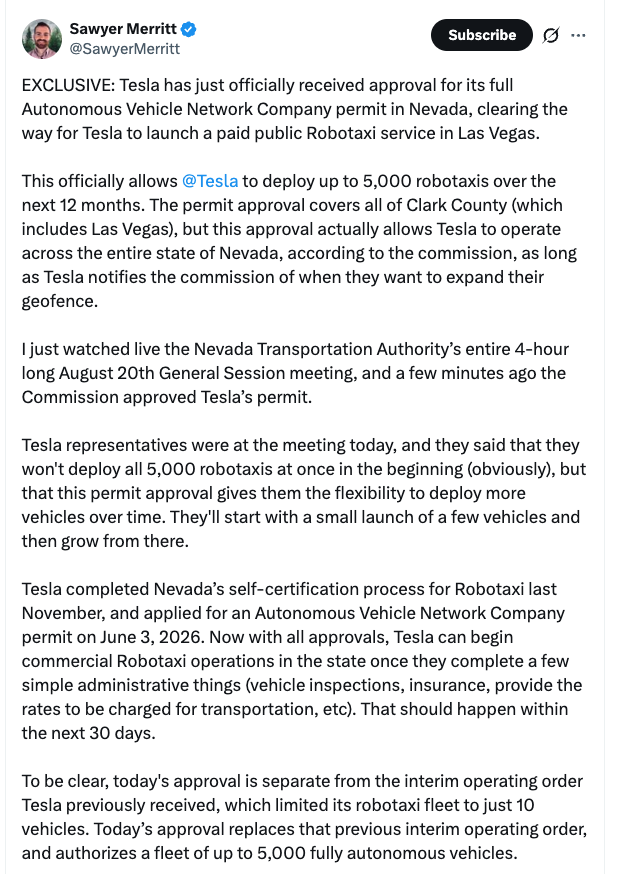
Tesla’s Model Y Robotaxis caused zero crashes or accidents from mid-June through mid-July, according to newly released NHTSA data. The only two incidents cited involving Tesla’s Robotaxi fleet were caused by human drivers in other vehicles making mistakes: • Incident #1 summary (in Dallas): The robotaxi was stopped at an intersection on a four-lane street in Lane #1, at a red left arrow light in the left-turn-only lane. An SUV behind the robotaxi activated their right turn signal and initiated a lane change into Lane #2, a straight-through lane, and collided with the left side of a passenger vehicle that was proceeding straight in Lane #2, before colliding with the right side of the robotaxi. There were no passengers. • Incident #2 summary (in Austin): The robotaxi was pulled over and in park on the right side of an alleyway. A passenger vehicle that was parked to the right reversed and collided with the right side of the robotaxi. There were no passengers. Sawyer Merritt (@SawyerMerritt) on X

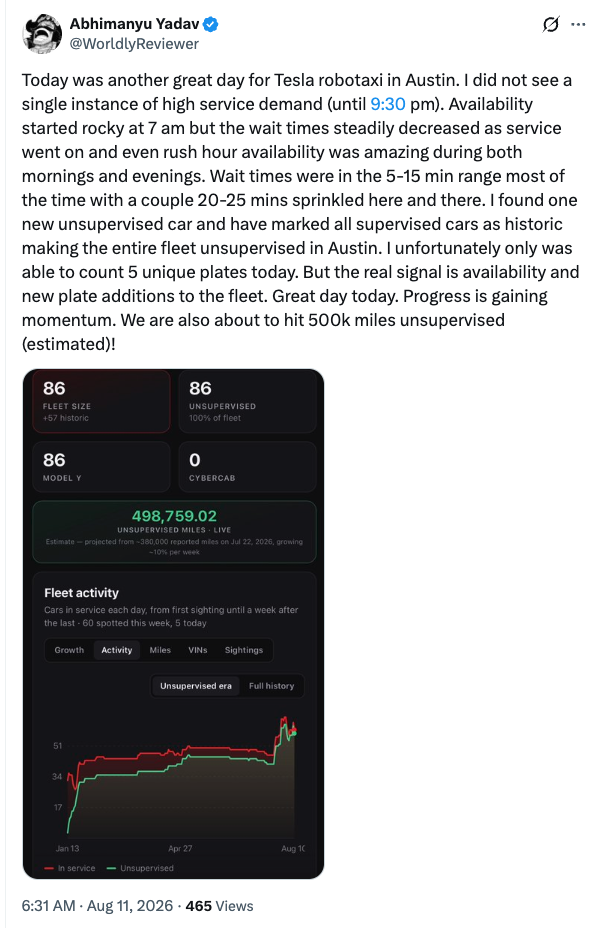
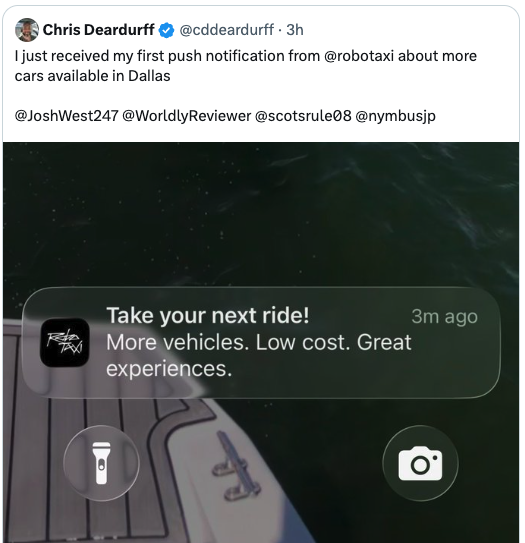
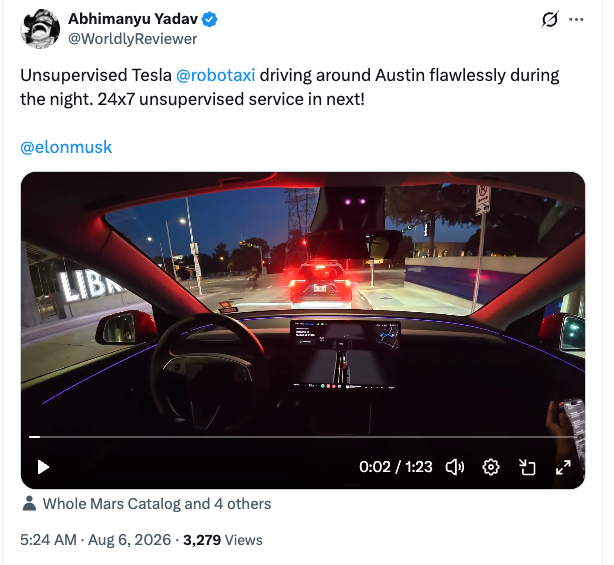
Fully unsupervised rides are now also available at night in Austin. From other comments, they are still using passenger-monitors for rides including highways.
Abhimanyu Yadav (@WorldlyReviewer) on X
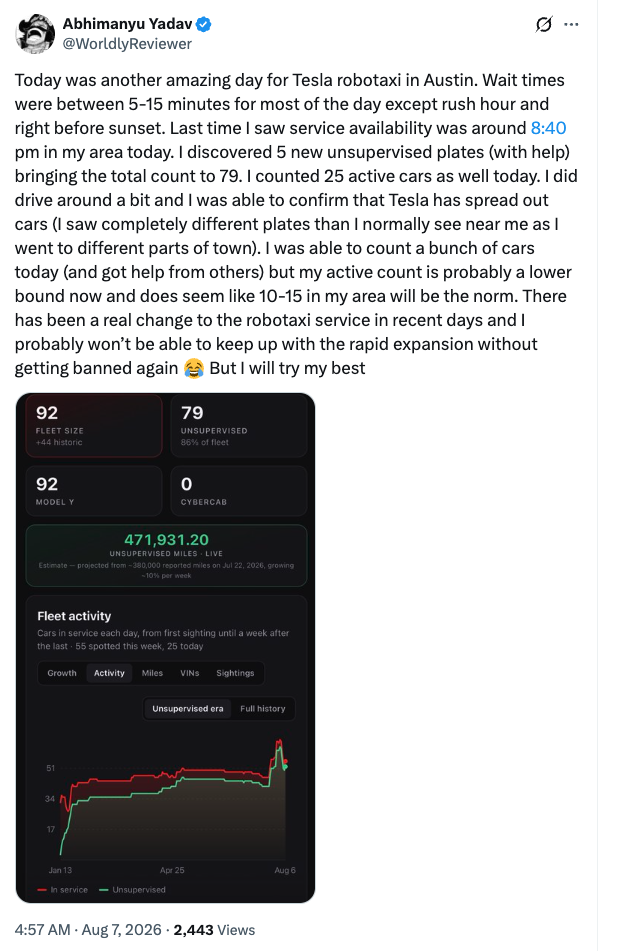
Apparently, there is a new guy daily tracking availability
Abhimanyu Yadav (@WorldlyReviewer) on X

@MarkosGiannopoulos Oh, last I had heard the passenger-seat monitor moved to the driver's seat for highway rides. Do you know when that changed?
As for this new tracker, any reason to think it's more accurate than robotaxitracker.com?
@dreev Not sure about the new tracker; it seems to be a single person tracking cars every day, doing rides and checking waiting times throughout the day (!) :)
He has tracked 50 different cars in Austin in August https://austin-robotaxi-tracker.netlify.app/ (which is similar to the current number of 67 cars in https://robotaxitracker.com/?provider=tesla&area=austin for the last 30 days)
I will have to look into the highway situation; I seem to recall some regulation issue.
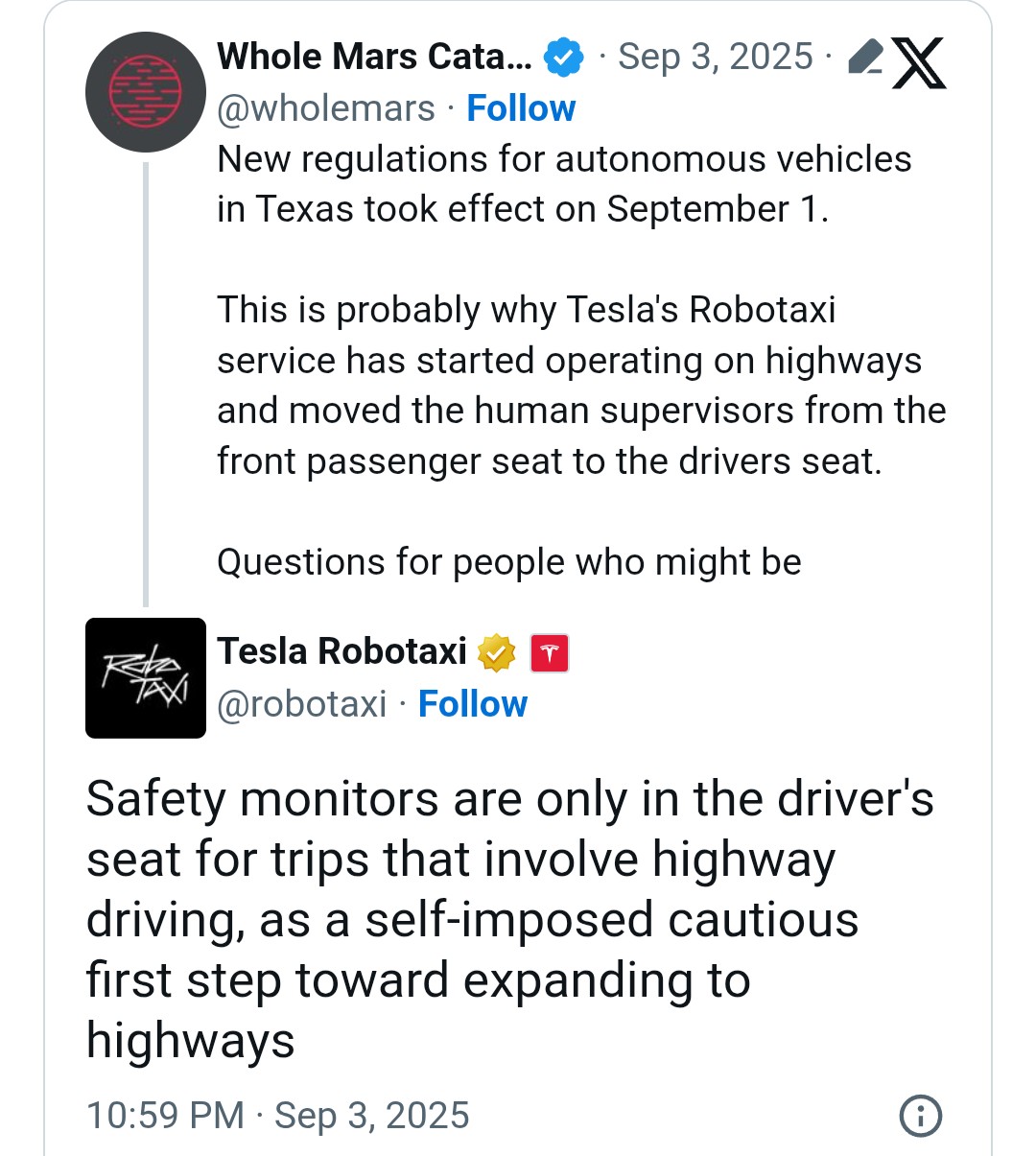
Not a reg issue according to Tesla Robotaxi, also confirmation that the safety monitors were still around. Also, because they weren't required by reg, is this not additional evidence that this market should've already resolved NO? Driver's seat = capacity to intervene immediately. Pls Resolve NO thx. 😂

@MarySmith There is no requirement in the market that rides need to not have someone in the driver's seat in both city and highway rides.
@MarkosGiannopoulos @MarySmith
It is possible to have a level 4 system but put someone there to observe out of caution. However does that apply to this case? If the system really was adequate to be considered a level 4 in June or August 2026, then we would expect to see continuing growth of the system because it was good enough and the monitors being removed within a few months.
Seems like there were several incidents of poor driving that prompted official inquiries in ~July 2025. I think the robotaxis had a robotaxi command and control shell with v14.0.x driving software loaded into that. There were lots of v14.1.x driving software releases in ~October and 14.2.x and 14.3.x from Nov. We first knew of monitor less vehicle 18 Jan 2026 and by 22 Jan 2026 they were giving rides to the public. It is possible from comments made at earning calls that there were monitor-less tests right at the end of 2025. V14.2.x onwards may have been quite a bit better and been the proper fix for several known issues rather than working around problems in earlier versions.
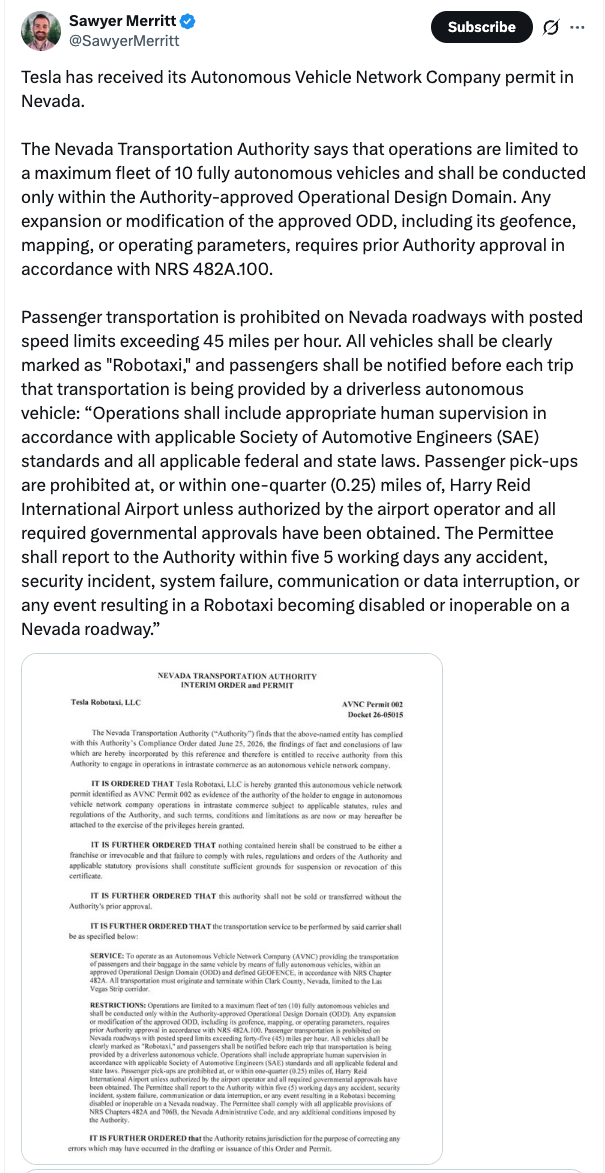
Now we have a significant ~62.5% retrenchment of VMT and it seems they are waiting for v15 before starting a significant expansion of service.
I think this all paints a picture of the software not being ready at June or August 2025. Maybe it reached the level of being good enough to be level 4 somewhere in October 2025 to January 2025 or maybe you could consider it is still not good enough yet because it isn't being expanded and might only become good enough when v15.0.0 or v15.0.2 or whatever is released.
As you can tell, I maintain you can't really launch a [level 4] system if the system isn't up to the level required at that time.
We ideally want a launch event after the system is up to the level required. Maybe when v15 is adequately tested Tesla will have a launch event after which they really start rapidly growing expansion without major retrenchment events. That would be helpful and might give us a more plausible launch date of a system that seems up to the standard required. If they don't then we seem left with launch possibilities as
a) June 2025 launch but it seems like the system wasn't really ready then.
b) 22 Jan 2026 launch of properly monitor-less robotaxi rides. Tesla didn't make a huge fuss of this as a launch event but it seems the nearest thing to a launch event after the system was good enough. It is quite possible history won't remember this date preferring to quote the June 2025 date.
c) v15 released for public use date (assuming that seems good enough to scale deployment) but if there isn't any fuss made of it as a launch date maybe it doesn't seem like the relevant launch date.
If history's conclusion is that it was available to the public in limited ways from June 2025 but the rapid expansion didn't really start until Nov 2026 [or some date like that] then I think it would be reasonable to conclude the system wasn't really ready at Aug 2025 and 22 Jan 2026 or v15 release date is when it is properly launched. Might take a while before we know how history will view it.
But now we are here in Aug 2026, may as well wait at least until we have a graph of VMT in the year after August 2025 before making an effort to persuade creator he needs to grow a backbone and reach a decision.
@MarySmith markos is right about highways. See faq items 4 and 5.
In terms of restrictions on operating domain specifically the robotaxis are actually pretty far beyond the minimum this market required.
@ChristopherRandles well said. This matches my thinking pretty well. Lots of ways for a NO to end up unambiguous, hence my inclination to keep waiting. But I'm listening if the consensus is that continued waiting is just too annoying. I do think that so far there's still enough ambiguity that I'd probably want to resolve to a (low) probability if forced to resolve now