
Living species. At least one specimen must break 1kg. (For aquatic species, this ignores the weight of water that can be easily removed, e.g. wringing out a sponge.)
In order to resolve YES, the scientific community must come to recognize it as a distinct species in between market creation and close. If there was a debate over whether to consider a variation a different species, that doesn't count.
 1,000
Pessoas também estão operando
The new cat should qualify!
@StepanBakhmarin my impression was that this was pretty clearly a re-assesmemt of known cat diversity (we knew there were tiger cats in the area, now we used genetics to see those are actually a new species), not an animal that was previously unknown, so out of scope of the question...
@AIBear if "genetics showed one species is actually two" counted, there would be a clean example with northern green anaconda (e.g. https://www.wral.com/archive/21297362/)

@AIBear We knew before market open that there were cats that were different in some way, and this study was only confirming that they're genetically distinct?
@IsaacKing, okay, let me get my take in here.
If you want a species were no zoologist has ever seen an individual of this species prior to its discovery, that's a really high ask. The way most species discoveries happen nowadays is that there is some group of animals that no one pays close enough attention to, and therefore no one can reliably distinguish the species within that group. So when someone comes along and stares at the group for some time, it turns out that there were a few species clumped together as one. Like, say, some deep-sea crustacean, with the genus described by some dude in the nineteenth century. How many people are there in the world who can identify this family of deep sea crustaceans? A few dozen at any moment in time, maybe. All of the information available about the species is the dude's description in French and Latin that someone translated to English in the sixties, the dude's drawing of the type specimen that may match reality to a varying degree, and (maybe) two entirely unhelpful blurry photos on gbif.org. A zoologist pulls out a trawl with something like that thing in it. They have maybe seen it a few times before, maybe not. It kinda matches the description and the drawing, but this spike on its fourth leg is not as long as in the picture... They identify it as the only know species of that genus, maybe hedging with 'cf.' or 'aff.', the specimen is fixed in ethanol and placed in some museum's collection for the next three decades, with the label saying the name of the species and the zoologist's remark about the spike being too short. And in thirty years someone decides to make a revision of this genus as their PhD thesis, emails a bunch of museums to get some samples, gets some DNA sequences and it turns out that the spike was important and that it is, in fact, not the same thing as the French dude saw two hundred years ago. So it's not that no one has seen that species before it was described, but neither was there a debate about it's status, if you don't consider one label in a jar a debate. It's just that it has always been labeled with the name of the closest species that has a proper binomial name because no one new better.
I couldn't get the full text of the cat paper, it's paywalled, but as far as I understand it, the problem here was that the population in question lives in a really remote area and is generally weary and hard to come by. I am sure that some zoologists have seen those cats, and labeled them Leopardus tigrinus, i.e. the name of the closest properly described thing, because no single person has seen enough of them from enough different locations to be able to tell the difference. The abstract of the paper makes it sound like the population that is being described as L. tilcayo was not previously considered a separate subspecies, though there are a few subspecies that they are elevating to the rank of species (see figure). I think that counts fare and square.
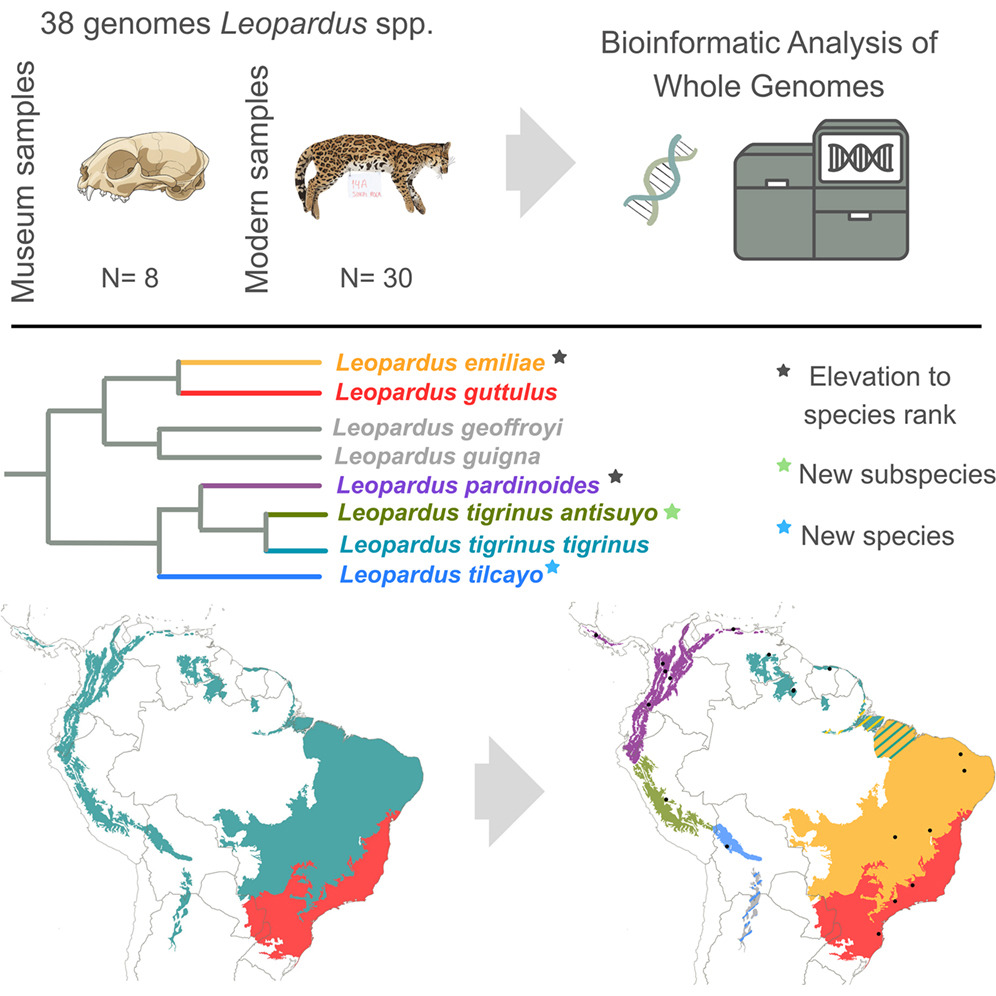
But I will, however, also note that the topology of the tree in the figure does not exclude the possibility that L. tigrinus s.s., L. pardinoides and L. tilcayo will be reduced to synonyms of L. tigrinus s.l. again in the future, though it is unlikely if the distinction is indeed based on the whole-genome sequences. But again, if someone has the full text, please send it my way.
A fun new candidate: A new species of supergiant Bathynomus A. Milne-Edwards, 1879 (Crustacea, Isopoda, Cirolanidae) from Vietnam, with notes on the taxonomy of Bathynomusjamesi Kou, Chen & Li, 2017 a recently discovered large marine isopod (some potentially nightmare fuel in the pictures). The weight of the specimen found is not recorded, but it is noted that in the commonly found B. jamesi largest individuals "measure 415 mm and 410 mm in length, respectively and weigh more than 2.6 kg". The largest specimen of B. vaderi (after Darth Vader!) reported measures 325mm which should place it somewhere near the 1kg mark....
@AIBear OK, probably not over 1kg. A closely related (if not identical) species reports weights around 300g for individuals with about 220 mm in length (Table 1: A new species of supergiant Bathynomus A. Milne-Edwards, 1879 (Isopoda: Cirolanidae) from the Paracel Islands, South China Sea ).
@AIBear OK, so this news report (Giant ‘Darth Vader’ sea bug discovered off the coast of Vietnam | CNN ) reports weight over 1 kg (refers to the study I already linked...) 🤔 . And like just assuming weight grows with the cube of length, the previously reported values are quite consistent with about 1kg for 325 mm in length....
See the log-log plot of length vs. weight for B. Vaderi (new species) vs. B. jamesi - the vertical line at 325mm shows the larges specimen with unknown weight. All the B. jamesi with reported weights are smaller, but their weight-to-length ratio is consistent with that of vaderi....


@Charlie From the underlying paper, it is somewhat unclear whether this is a new species never seen before or a known variant now recognized as a new species. In any case, the description in the paper makes it clear the specimen is just couple centimeters in size and thus almost certainly weighs less than 1kg.


@Charlie You are welcome. Just for transparency, the underlying paper is at https://doi.org/10.1071/IS22057 (paywalled, unfortunately)
Will the question resolve Yes if a specimen is discovered in an earlier year and a paper describing the new species is published in 2023-2027?
Is it required that the publication specify the specimen weight or if it the specimen is reasonably much larger than 1kg (like a 2m snake), then does the question resolve Yes?
@WesleyJB If I can be confident the weight is >=1kg, that suffices.
Description updated for the first question.
@IsaacKing I think there has been one then:
Species in Disguise: A New Species of Hornshark from Northern Australia (Heterodontiformes: Heterodontidae), Received: 20 June 2023 / Revised: 10 July 2023 / Accepted: 11 July 2023 / Published: 12 July 2023, https://www.mdpi.com/1424-2818/15/7/849#
"Heterodontus marshallae n. sp. was previously considered to be conspecific with H. zebra from the Western Pacific."
If you put the 54.1cm length of the holotype into a sporting fish calculator, the weight estimate range is 1.25-3.6kg and if you put in the largest 60.1cm paratype specimen in, the weight estimate is 1.7-5kg. https://www.omnicalculator.com/sports/fish-weight
"Holotype: WAM P.35408-007, adolescent male, 541 mm TL [total length], west of Exmouth Peninsula, Ningaloo Marine Park (Commonwealth waters), Western Australia, 22°22.946′ S, 113°40.308′ E, 210–212 m depth, 23 November 2022.
Paratypes (n = 6): CSIRO CA 3286, juvenile male, 432 mm TL, north of Port Hedland, Western Australia, 18°33′ S, 118°22.3′ E, 150 m depth, 28 March 1982; CSIRO H 6581–01, female, 580 mm TL, northwest of Cape Leveque, Western Australia, 14°58.69′ S, 121°40.18′ E, 191–202 m depth, 28 June 2007; NTM S.12929-001, adult male, 575 mm TL, north of Bathurst Island, Arafura Sea, Northern Territory, 10°10.02′ S, 130°04.02′ E, 125 m depth, 16 November 1990; NTM S.18275-001, egg case (wet), southeast of Evans Shoal, Arafura Sea, Northern Territory, 10°08′ S, 130°05′ E, 131 m depth, 1 October 1998; WAM P.26193-010, female, 355 mm TL, 150 km north-northeast of Rosemary Island, Western Australia, 22°22′ S, 113°29′ E, 170–172 m depth, 16 May 1978; WAM P.30424-001, adult male, 601 mm TL, east of Exmouth Peninsula, Western Australia, 22°22′ S, 113°40′ E, 221–229 m depth, 29 September 1990."

@WesleyJB Nice find - I am not sure this clears the bar set by "If there was a debate over whether to consider a variation a different species, that doesn't count." as the paper has "Heterodontus marshallae n. sp. was previously considered to be conspecific with H. zebra from the Western Pacific."
It doesn't look there was a significant debate over whether it was a variation. Previous authorship was aware that there were differences between the specimens of the H zebra and the new H Marshallae, but hadn't yet declared it a new species. "Naylor et al. found that the sequence of the NADH2 gene of H. zebra from northern Australia was different from H. zebra from Japan and Malaysian Borneo. They suggested that the northern Australian population is probably an undescribed species and is referred to as H. cf. zebra."
Can we get a verdict please?
@IsaacKing Oh, I see the confusion. My understanding was that the criteria were meant to exclude the case where a paper settles a preexisting debate whether something is a separate species (since that means the new finds are not completely new). Now I see that you meant to exclude situations where the paper starts a new debate . As a yes holder, I obviously don't protest a positive resolution.
@IsaacKing From the paper:
Naylor et al. [14] found that the sequence of the NADH2 gene of H. zebra from northern Australia was different from H. zebra from Japan and Malaysian Borneo. They suggested that the northern Australian population is probably an undescribed species and is referred to as H. cf. zebra. The fact that H. cf. zebra was genetically closer to H. portusjacksoni (average pairwise difference of 13 nucleotides for NADH2) than it was to the true H. zebra samples (average pairwise difference of 24) provides compelling support for the separation of the northern Australian population as a distinct species."
And
In this paper, specimens of H. cf. zebra from northern Australia were compared to true H. zebra specimens from the Northwest Pacific and to the type of Cestracion amboinensis to determine whether they refer to a new species.
They further refer to https://ris.cdu.edu.au/ws/portalfiles/portal/45696628/Kyne_etal_Shark_Action_Plan_2021.pdf which has
The action resolve nomenclature is required for 8 species, where the current names of these species may not be correct for the species
occurring in Australian waters: [...] Heterodontus zebra, [...]
So this appears to be a redefinition to me...