Resolution criteria
This market will resolve to YES if, between September 9, 2026, and December 31, 2026, at 11:59 PM UTC, a proposed solution for at least one of the remaining five Millennium Prize Problems is formally announced or published.
The five eligible problems for this market are:
P versus NP
The Riemann Hypothesis
Yang–Mills Existence and Mass Gap
The Hodge Conjecture
The Birch and Swinnerton-Dyer Conjecture
For the purposes of this market's resolution:
Navier–Stokes Existence and Smoothness is excluded from resolving this market to YES. OpenAI announced a proposed solution to Navier–Stokes on September 8, 2026. This market specifically tracks whether another (i.e., a third) Millennium Prize Problem will have a solution claimed or published in 2026.
Poincaré Conjecture is excluded as it was solved prior to 2026.
The proposed solution must be put forward by a recognized mathematician, a reputable academic institution, or a major AI/technology research organization (such as OpenAI, Google DeepMind, Anthropic, etc.).
The announcement must be accompanied by a published paper, a public preprint (such as on arXiv), or a formalized computer-verified proof (such as in Lean or Coq).
The solution does not need to be officially verified or awarded by the Clay Mathematics Institute by the end of 2026 (as CMI rules require a two-year waiting period after publication). However, the solution must not be widely debunked or retracted by the mathematical community before December 31, 2026.
If no other eligible Millennium Prize Problem has a proposed solution announced by the end of 2026, this market will resolve to NO.
Background
The Millennium Prize Problems are seven mathematical puzzles selected by the Clay Mathematics Institute in 2000, each carrying a $1 million prize for a correct solution. For over two decades, the Poincaré Conjecture (solved by Grigori Perelman in 2002–2003) was the only solved problem.
On September 8, 2026, OpenAI published a paper claiming that an unreleased internal AI system had solved the Navier–Stokes existence and smoothness problem by proving that the equations can develop a singularity in finite time. This market is designed to predict if the rapid acceleration of AI capabilities or human mathematical breakthroughs will result in yet another of the remaining five unsolved classic problems being solved before the end of 2026.
Update 2026-09-10 (PST) (AI summary of creator comment): If a proposed solution is neither widely debunked nor widely accepted (remains controversial) by December 31, 2026:
The creator will delay resolution for 2 to 3 months after the market closes.
If the proof remains controversial after this period, the creator is leaning toward resolving the market to NO or N/A (rather than YES), and will consult with moderators and mathematicians to make a final decision.
Update 2026-09-21 (PST) (AI summary of creator comment): - The controversy clause applies strictly to the mathematical validity of the proof itself (e.g., disputed proofs like the ABC conjecture), not to public relations or circumstances surrounding the announcement.
An announcement similar to the Navier-Stokes release will resolve to YES.
 1,000
Pessoas também estão operando

@JussiVilleHeiskanen yes and i don’t think they’ll figure out how to manage this huge pr issue by eoy either
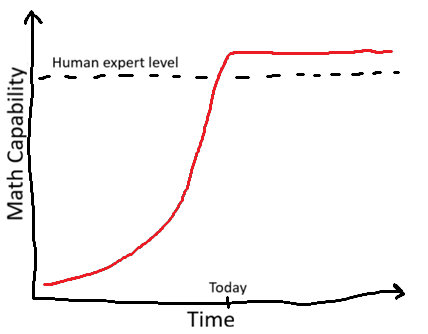
@Haiku Do you think there is no physical limit on math capability per kwh? Imho there is and humans are pretty close. Also in most scenarios where I'm losing my position it would be the least of my worries
@Aurora_Glow humans are pretty close? genuinely what the fuck are you talking about? almost all power consumption even from a professional mathematician on any given day is dedicated to things other than generating math progress
like yeah, the brain is more power efficient than GPUs/TPUs, but it's also primarily dedicated to solving other problems. it is an absurd proposition that the algorithms used by brains to reason about math are anywhere close to optimal
this is also irrelevant, AI throws millions of times more power at problems than any group of humans does
@Plant * By pretty close I meant obviously a few orders of magnitude off. Also you cant really parallelize ai without signoficant efficiency loss, you won't have the same data throughput between 1000 llms as in one llm running on the same fast memory, it is documented in last OpenAI swarms. So yes you can make systems 10 - 10^3 times better than humans in reasoning about math, I'm not denying it. All im saying is humans are good enough, and after all those human-years there is probably not much space for improvement left
@Aurora_Glow There is a physical limit to everything, and most of those physical limits are way, way beyond anything that humanity has ever seen. People who have looked into the arguments from information theory tell me that there there is room for about six orders of magnitude above human intelligence.
I am confident at about 1000 to 1 that LLMs have not peaked, and that's just LLMs. There are at least half a dozen different ways that we know LLMs can continue to scale up from here, where we know for a fact that those scaling axes are nowhere near saturated. And completely new architectures could still emerge any day.
Something that has made me better than most people at predicting AI progress is my realization that the transformer architecture encodes "true intelligence," in the same sense that our cortical neurons do, just with a different algorithm. There's no trick, and it turns out that intelligence just isn't that hard to create. Back when Dario Amodei was saying that it's 50/50 whether LLMs would keep scaling, I said that doesn't make any sense, it's more like 70/30 or 80/20. I predicted IMO gold in 2025, and a Millennium problem before 2028. When Daniel Kokotajlo lengthened his timelines into the 2030s, I correctly predicted that he would shorten them again.
I have earned my confidence. That doesn't mean this specific market will work out for me, but there is no room for believing that AI progress will just stop, unless we intentionally make it stop. I am 100% on board with making it stop, and I hope that loses me all of my Mana.
@Haiku So we are a few orders of magnitude off on space for intelligence above human, which is close enough considering all uncertainty. All we have to see is how much of this 6 orders happens this year, and if it would be enough to solve some millenium problem in a few months, after thousands of humans failing to solve them in decades.
@Aurora_Glow Yeah, I mean, that seems to be going pretty well so far. Navier-Stokes was one-shotted in 88 hours, and the solution the AI system used didn't build on the past 10 years of human progress on the problem. We've also seen progress on BSD, Hodge, the Riemann hypothesis, and Yang Mills, as well as a complexity theory result relevant to P vs. NP (which isn't the same thing as progress on that problem, but it has raised eyebrows). It's hard to quantify the amount of progress, or the relative difficulty of other Millennium problems to Navier-Stokes, but that just puts error bars of a few months on when they will be resolved. It might stall out until early next year, but that seems unlikely to me on vibes, given how much has been done so far.
@Haiku I mean, I just think there are only 2 months left, labs aren't exactly falling over themselves to spend another $20 million to solve a second problem, and Polymarket is pricing this at about 25-30%, depending on how likely you think someone other than a frontier lab is to release a solution.
@bens it’s basically an incredibly expensive pr campaign that has an 80% chance of having the opposite effect
@bens Fair enough, but OpenAI is still plowing forward, and I don't think it will be that expensive.
@bobalobascrob It doesn't make sense as a PR campaign. It's more for the investors than the public. And it isn't necessarily that expensive, for what it gets them.
@Haiku eh regardless it’s probably not worth it for them
as for investors i don’t think “hey our models can solve 1 millennium problem” and “hey we can solve two now” makes much of a difference
@Haiku It’s great marketing because it’s a costly signal of true capability. $20M for a bit more share and investor energy in a $5T+ value space seems pretty cheap.
And holding back makes no sense. How long until there’s a public model strong enough for mathematicians to do this on their own? 6 months?
@Mactuary on the marketing point… do you think openai got more good press or bad press from navier? even if it was net positive it was definitely a lot more controversial than they expected.
this stuff can fall both ways. it’s not a $20m return on a multibillion dollar upside. it’s a $20m price to play a multibillion dollar coin flip game where if you lose you lose billions
frontier labs are quite open to taking risks in the form of r&d but pr? especially with the current market sentiment? i think they would pass
@bobalobascrob I actually think it was overall positive. Sure, there was lots of bad press, but I think it shifted the vibes on “who has the best model”.
Also, maybe there wouldn’t be the pressure if this were truly a duopoly, but ANT and OAI don’t want a #3 publishing these results.